The system · Item 06
How Singapore political parties are structured, and who picks a leader
Cadre systems, ordinary-member systems, and what the difference means for who actually selects a leader.
Party structure looks like housekeeping until you follow one question through it: who chooses the people at the top? The answer differs between Singapore’s parties, and the difference is not cosmetic.
Registration comes first
Every political party in Singapore is a society, and every society must be registered under the Societies Act. Registration is granted by the Registrar of Societies, can be refused, and can be cancelled. A party that is not registered cannot lawfully operate, and a party whose registration is cancelled ceases to exist as a legal entity — its assets, its accounts and its ability to field candidates all follow.
Parties must file annual returns, maintain accounts, and notify changes to their constitutions and office-holders. Donations are separately regulated under the Political Donations Act, which restricts foreign sources and requires reporting above a threshold.
This is the common floor. Everything below it varies by party constitution.
The cadre system
The People’s Action Party operates on a cadre model, and it is the structural feature most often cited about it.
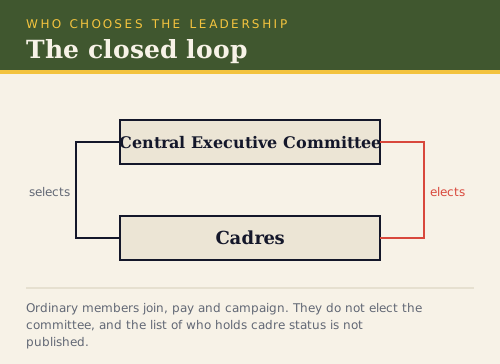
Party membership is open in the ordinary way. But ordinary members do not elect the party’s Central Executive Committee. That is done by cadres — a smaller body of members selected from within the party. Cadres are appointed by the existing leadership, not elected by the membership, and the list of who holds cadre status is not published.
The loop is deliberate and closed: the CEC selects the cadres, and the cadres elect the CEC. A member joins, participates, and may in time be made a cadre; but the route to the body that chooses the leadership runs through appointment rather than through the general membership.
The model is borrowed, structurally, from Leninist party organisation, and the party has never disguised the resemblance. The justification offered has been continuity and protection against capture: a leadership chosen by a vetted body cannot be taken over by an organised faction that signs up enough new members to win a ballot.
The criticism is the mirror image. A leadership that selects the electorate that selects it is insulated from the membership, and the absence of a published cadre roll means the size of that electorate is not externally known.
Ordinary-member systems
The other established parties — the Workers’ Party and the Singapore Democratic Party among them — run on ordinary-member models. Members in good standing elect the party’s central body at a party conference, on the terms set out in the party’s own constitution.
The practical differences follow directly:
Leadership can change through the membership. A contested internal election can replace an incumbent. The Workers’ Party leadership transition in 2001 and the contested internal elections since are the visible instances.
Factional risk is real. The thing the cadre system is designed to prevent is a live possibility here, and internal splits in Singapore’s opposition parties have produced new parties more than once.
Membership numbers matter. In a system where members vote, recruiting members is a route to influence, and disputes about eligibility and timing of membership have practical consequences.
Why newer parties keep appearing
Singapore has had a steady supply of new parties, and the pattern behind most of them is the same: a disagreement inside an existing party, followed by a departure and a fresh registration rather than a fight for control of the original.
The Progress Singapore Party, registered in 2019, is the clearest recent example of a party formed around a figure who had previously belonged to another. Registration under the Societies Act is available to any group that meets the requirements, so the barrier to founding a party is administrative rather than prohibitive — which makes departure a more available option than internal struggle.
The barrier is not to founding a party. It is to contesting seats, and that is set by the GRC system: a party must field a complete slate of three to five candidates to contest most constituencies. A new party with two credible candidates in an area still cannot enter the contest there.
The party and the seat
One provision links party structure directly to parliamentary arithmetic. Under the Constitution, a Member of Parliament who ceases to belong to the party for which they stood at the election vacates their seat.
This means expulsion from a party is not an internal matter with internal consequences. It removes a member from Parliament. Crossing the floor, in the sense familiar from other Westminster systems, is not available: a member who leaves their party leaves the House.
That provision does more to enforce party discipline than any whip could, and it is why the internal governance of a party — who can expel whom, by what process, and with what appeal — is a question about Parliament rather than only about the party.
Branches, and what an MP’s party organisation does
Below the central body, parties organise by constituency branch. For the governing party, the branch structure overlaps substantially with the machinery of constituency service: the weekly Meet-the-People session is run out of it, and the volunteers who staff it are largely party volunteers.
That overlap is one of the more consequential structural facts in Singapore politics, and it is symmetrical in principle but not in effect. An opposition MP who wins a constituency inherits the same duty and runs the same sessions, but does so with the resources their own party can raise. A party with no elected seats has no constituency to organise in at all, which is why opposition parties maintain a presence in wards they have never won — the alternative is starting from nothing each election.
What is not published
Several things that would be public in other systems are not, and the absence shapes what can be said about party structure:
- The cadre roll of the PAP, and therefore the size of its selecting body.
- Membership figures for most parties, which are not required to be published.
- Internal candidate-selection processes, which are set by party constitution and not by statute.
Party constitutions themselves are lodged with the Registrar of Societies. What is filed is a matter of record; what is routinely published varies by party.
Candidate selection
Structure determines who leads a party. A separate process determines who stands for it, and the two are not the same.
Selection is governed by party constitution rather than by statute, and practice varies. The governing party’s process is extended and well documented in outline: potential candidates are identified, put through a series of interviews and assessments over months, and introduced publicly only near the end. Tea sessions, psychological assessment and vetting are part of the described sequence.
Opposition parties run shorter processes, generally because the timeline is compressed and the pool smaller. A candidate may be recruited within months of an election rather than years.
The consequence shows up at nomination day. A party that has spent two years assembling slates can field complete teams across the map. A party assembling candidates in the months before a boundaries report can find itself unable to contest a constituency it intended to, because a five-member GRC requires five certified candidates and four is not a partial entry.
Money
Party finance is regulated but modest by international comparison, and the rules shape structure.
The Political Donations Act restricts donations to Singapore citizens and controlled companies, requires reporting of donations above a threshold, and bars foreign sources outright. Election expenses are capped per candidate and must be declared after the poll.
The combination — no foreign money, capped spending, a citizen-only donor base — means parties do not build the large professional apparatuses that money-intensive systems produce. Most party work is done by volunteers, and the branch structure is a volunteer structure. That is why the constituency branch matters as much as it does: it is not one arm of a party organisation among several, it is most of what the organisation physically consists of.
What happens when a party stops existing
Parties are deregistered, dissolve, or merge, and the consequences run through the members.
An MP elected for a party that ceases to exist is in an unusual position, because the constitutional provision is framed around ceasing to belong to the party for which one stood. Mergers have been handled by the parties involved rather than tested at law, and the question has not been litigated to a conclusion.
For members, deregistration ends the entity that holds the assets and files the returns. For the electoral system, it removes a party from the register and with it the ability to field candidates under that name. Both are administrative facts with substantial practical weight, and both rest on a decision by the Registrar rather than a vote of anyone.
The same is true in reverse, and it is the reason new parties keep appearing rather than existing ones keep changing. Registering a fresh society is an administrative step with a known process and a known timeline. Winning a contested internal election inside an established party is neither. When a faction concludes that it cannot prevail internally, the cheaper route is out — and the cost of that route is paid later, at nomination day, when a party six months old has to find five certified candidates for a single constituency.
Where to check this
Registration requirements, filing obligations and the grounds for cancellation are in the Societies Act. Restrictions on donations are in the Political Donations Act. The provision that an MP vacates their seat on ceasing to belong to their party is in the Constitution of the Republic of Singapore. The register of political parties, and the office-holders each has filed, is maintained by the Registrar of Societies.
FAQOn this page
What is a cadre party?
One whose central executive is elected by a restricted group of members designated by the leadership, rather than by the ordinary membership. The cadre roll is not published.
Do other parties use the same model?
No. The other parties run ordinary membership models in which members elect their own organs directly.
How are candidates selected?
Through a structured process of interviews and assessments before anyone is fielded, which is why the resulting profile is so consistent.
Are party accounts public?
Registered parties must file audited annual accounts, and the basic registry information is public.