Our Class Notes
A field guide
to the House
Singapore
Issue 01

Singapore Parliament explained: GRCs, Question Time and the whip

Singapore's politics is not hard to follow once somebody explains the machinery. The trouble is that most explanations assume you already know what a GRC is, why an NCMP sits in the House without having won a seat, or what happens to an MP who votes against their own party.

These are the notes for that. Each entry answers one question, cites the record it came from, and stops.

How Singapore Parliament works is a question with a documented answer: a single chamber, a government drawn from it, and a written record of every sitting. What follows is the Singapore Parliament explained one piece at a time, starting with the pieces that have no equivalent anywhere else. Anyone asking how Singapore Parliament works usually wants three of them: the GRC, where a whole team wins or loses together; the unelected seats; and the party whip, which here costs an MP their seat the day they leave the party that fielded them.

The fourth is Question Time, the ninety minutes at the start of a sitting where ministers answer. That is the Singapore Parliament explained in the order that makes it legible: how a GRC is won, who sits without having won one, what the whip does, and what happens at Question Time when the prepared answer runs out.

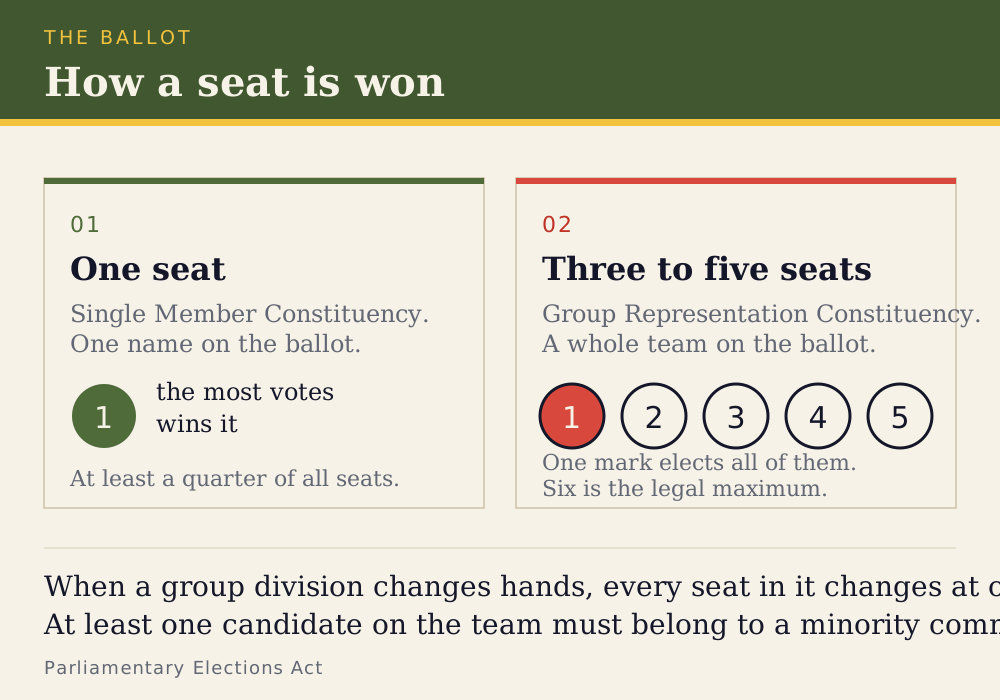
Two panels comparing a single-member constituency, which returns one seat, with a group representation constituency, where a team of three to five wins or loses every seat together.
One mark, one seat — or one mark, five

01 The system, item by item

The Singapore Parliament, item by item

01

What is a GRC, and why does Singapore have them?

A Group Representation Constituency is contested by a team of three to five candidates rather than one, at least one of whom must be from a minority community. Introduced in 1988. It is the reason a party has to field a full slate to contest most of the map.

02

What does a Non-Constituency MP actually do?

An NCMP is an opposition candidate who lost but performed well enough to be offered a seat. Since 2016 they vote on everything an elected MP votes on. The scheme guarantees a minimum opposition presence without anyone having won the ward.

03

What is the party whip, and what happens when it is lifted?

The whip instructs MPs of a party how to vote. When it is lifted, members vote as they choose — which in practice has happened on a small number of conscience questions. Lifting it is itself a political signal.

04

How does Question Time work?

Ninety minutes at the start of a sitting. MPs file up to three questions seven days ahead; ministers answer and can then be pressed by anyone in the House. It is the main tool Parliament has for putting an office-holder on the spot without warning.

05

Who draws the electoral boundaries, and when?

The Electoral Boundaries Review Committee. It is convened by the Prime Minister, reports without a fixed deadline, and the release of its report is generally read as the starting gun for an election.

06

How are Singapore's political parties structured?

Cadre systems, ordinary-member systems, and what the difference means for who actually selects a leader.

07

What is a Meet-the-People session?

Weekly, in every ward, for decades. Residents queue to put a problem to their MP in person — a debt, a housing appeal, a school placement. It is the most consistent point of contact between an MP and the people who elected them, and it has almost no equivalent elsewhere.

02 By the numbers

1,025
oral questions filed across 16 ministries between January 2016 and July 2019
Which MPs have asked the most questions?
62
questions from the single most prolific questioner in that term, Leon Perera
Which MPs have asked the most questions?
39
questions about one public transport operator, filed by 19 different MPs
Which MPs have asked the most questions?
How to use
this reference
Sources

How this reference is organised

Three kinds of page, and the difference between them is the difference in what they claim.

The system holds the explanations. Each entry takes one part of the machinery — a Group Representation Constituency, the office of the whip, the ninety minutes of Question Time, the committee that redraws the boundaries — and sets out how it works, what it was introduced to do and what is argued about it. These are written to stay accurate for years rather than for a news cycle, because the rules they describe change rarely and are published when they do.

The counts hold the figures. Each one takes a specific question, answers it from a published record, and states the rule that produced the answer alongside the number itself. A count of oral questions is not a count of questions; a count of enforcement actions is not a count of falsehoods; a financial year is not a calendar year. Every page here says which it used, and every page offers the same rows as a file.

The notes are fixed to a moment. They were written about a particular debate, report or week, and they are kept at the address they were published on rather than quietly updated, because a dated observation that has been edited to look current is worse than one that is plainly old.

The glossary runs underneath all three. Most parliamentary vocabulary in Singapore is inherited from Westminster and means what it means anywhere else; the entries worth looking up are the local inventions, and those are the ones a reader meets first.

Where the figures come from

Five recurring sources, all of them public. Hansard, the verbatim record of proceedings published by the Parliament of Singapore and searchable by member, ministry and sitting. The statutes themselves. The reports of the Electoral Boundaries Review Committee. Results published by the Elections Department. And the annual reports and financial statements of individual town councils.

Nothing here is surveyed, modelled or estimated. Where a figure comes from a document, the document is named precisely enough to find, and the window it covers is stated with it. That second part is the one most often dropped in transit: a number travels easily and the rule behind it does not, so by the third citation the qualifier has usually fallen off.

What this does not do

It does not predict results, endorse parties or cover a campaign as a contest. Those are legitimate things to publish and there are publications that do them well; mixing them in here would cost these pages the one property that makes them worth citing.

It also does not resolve arguments the record leaves open. Where a question is contested, both positions are stated in the form their holders would recognise, and the page says which parts the documents settle and which they do not. A reference that quietly picks a side on a matter the record does not decide has stopped being a reference.

How to check anything here

Every count states its source, its window and the day it was made, and offers the same rows as a CSV with that information repeated in the file header. Every explanation names the instrument it describes. Any figure on this site can be taken back to the document it came from without asking anyone, which is the only test of a reference that matters.

Where a recount changes a figure, the page says what changed rather than replacing the number silently. A corrected total that arrives without a note is indistinguishable from a total that was always wrong.

Who this is for

Anyone who needs to know how the machinery works rather than who is ahead: a student meeting the terms for the first time, a reader following a debate who wants to know what a phrase in it means, a journalist checking a figure before repeating it, a researcher looking for the document behind a number.

None of those readers needs an opinion about Singapore's politics, and none of them is served by one dressed as a fact. What they need is the rule, the source and the window, which is what every page here is built to give. The scope and method are set out in full, including what is deliberately left out and how corrections are handled.
04 Recent notes

05 Glossary

Cut
— a symbolic reduction to a ministry’s budget, moved so that an MP can make a speech on that ministry’s policy.
Division
— a recorded vote, where each member’s position is registered individually.
Hansard
— the official verbatim record of proceedings.
Private member’s bill
— legislation introduced by an MP who is not a minister.
Standing orders
— the rules governing how the House conducts itself.
Supplementary question
— the follow-up an MP may ask after a minister has answered, and the part that cannot be prepared for.

FAQStarting here

Where is the official record of what Parliament said?

Hansard, the verbatim report published by the Parliament of Singapore, searchable by member, ministry and sitting. Every count on this site names the record it was taken from, so any figure can be followed back to the document that carries it.

How current are the figures?

Each count carries the day it was made, on the page and in the first line of its CSV, and each states the window the figures cover. Those are two different dates and both matter: the window says which period was counted, the day of the count says when the record was last read.

Can these figures be reused?

Yes, with attribution. Each count carries a citation line naming the original source, the window, the day of the count and the page, and the file repeats the same rows so nothing is lost between the table and the download.

Why are the older notes not brought up to date?

Because they were written about a particular week and are kept at the address they were published on. A dated observation edited to look current is harder to use than one that is plainly old, and the explanations in the system section are where the durable material lives.

Where should a reader start?

With the glossary if the vocabulary is new, because most of the confusion is in a handful of local terms. With the system section if the question is how a particular mechanism works. With the counts if the question is how many.

↑