The system · Item 03
What the party whip does, and what happens when it is lifted
The whip instructs MPs of a party how to vote. When it is lifted, members vote as they choose — which in practice has happened on a small number of conscience questions. Lifting it is itself a political signal.
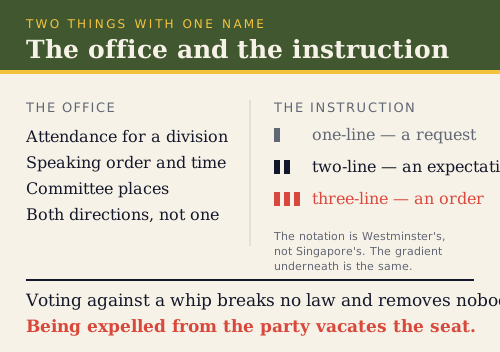
The whip is two things at once, and the confusion between them is the source of most misunderstandings. It is an office — a Member of Parliament appointed by their party to manage the party’s members in the House. And it is an instruction — the direction that tells those members how to vote on a given question.
When people say a vote was “whipped”, they mean the second. When they say someone “is the whip”, they mean the first.
What the office does
The Government Whip and the opposition parties’ whips run the mechanics of parliamentary business for their side. The work is unglamorous and almost entirely invisible from outside:
Attendance. Making sure enough members are present for a division, and present at the right moment. A government can lose a vote through absence as easily as through dissent.
Speaking order. Deciding which of a party’s members will speak on a bill, in what order, and for how long. Debating time is finite and allocated; someone has to divide it.
Committee places. Filling a party’s seats on select committees and standing committees.
Communication in both directions. Telling members what the party expects, and telling the leadership what the members will not accept. The second half is the part that gets left out of most descriptions, and it is the reason the office has real influence rather than merely real authority.
What the instruction does
Before a division, members are told how their party expects them to vote. In the Westminster systems Singapore’s procedure descends from, this instruction is graded by the number of times it is underlined — a one-line whip is a request, a three-line whip is an order. Singapore does not use that notation in public, but the underlying gradient is the same: some votes matter to a party more than others, and members are told which is which.
A member who votes against a whipped instruction is not breaking the law and is not removed from Parliament. The consequences are internal to the party: at the mild end, a conversation. At the severe end, expulsion from the party — which in Singapore does have a constitutional consequence, because a member who ceases to belong to the party for which they stood at election vacates their seat.
That last provision is why party discipline in Singapore is stronger than the absence of formal legal compulsion would suggest. The whip is not enforced by law, but the exit door has a legal consequence attached to it.
Lifting the whip
To lift the whip is to tell members of a party that on this question they may vote as they choose, and that the party will treat any outcome as legitimate. It happens rarely, and it is always deliberate.
The category of question involved is usually described as one of conscience — a matter on which a party judges that a collective position would be inappropriate, because the question turns on moral or religious conviction rather than policy. Debates on the status of section 377A of the Penal Code and related questions of sexual conduct and marriage have been the clearest Singaporean instances, and votes on those matters have proceeded with the whip lifted on more than one occasion.
The decision to lift is announced. That announcement is itself the signal, and it carries in two directions at once. It tells the House that the party accepts the question is not a party matter. It also tells the public that the party’s own members are not united, which is information a party does not volunteer lightly.
What lifting does not mean
It does not mean the vote is unimportant. The opposite is usually true. The whip is lifted on questions that are too significant to be settled by party arithmetic, not on trivia.
It does not mean the party has no view. Ministers and party leaders continue to speak and argue in the debate. What they give up is the instruction, not the advocacy.
It does not apply to supply. Budget and money bills are never freed. A government that loses a supply vote has lost the confidence of the House, so those votes are whipped by definition.
It is not the same as an open debate. A member may speak freely in almost any debate; the whip governs the vote at the end, not the speeches before it.
Who is exempt already
Two categories of member sit outside the party whip entirely, for structural reasons.
Nominated Members of Parliament are appointed rather than elected and are expected to be non-partisan. They belong to no party, so no whip applies to them. This is the point of the scheme: NMPs are meant to bring judgement from outside party politics, and a whipped NMP would be a contradiction.
Independents, in the rare cases where one is elected, are in the same position for the obvious reason.
Non-Constituency MPs are not exempt. An NCMP is a member of the party whose candidate they were, and that party’s whip applies to them exactly as it applies to its elected members.
Reading a division
When a vote is recorded — a division, in the formal term — the names and positions of individual members are registered. Most divisions in Singapore’s Parliament are not close, and many questions are resolved on the voices without a division at all.
That makes the exceptions worth watching. A division called on a question that could have been settled on the voices usually means someone wanted the individual positions on the record. And a division on a freed vote is one of the few occasions where the record shows a party’s members disagreeing with one another in public, with their names attached.
The whip in a small House
One feature of Singapore’s Parliament changes how the office operates compared with its Westminster originals: the governing party has held a large majority in every Parliament since independence.
Where a government’s majority is a handful of seats, the whip’s central task is arithmetic — counting, cajoling, and occasionally trading. Where the majority is overwhelming, the arithmetic is never in doubt, and the office’s work shifts toward managing debate, allocating speaking time, and handling the internal flow of information between backbenchers and leadership.
That is a real difference in emphasis, and it is why comparisons with Westminster whipping — the horse-trading, the pressure campaigns, the famous confrontations — describe a job that Singapore’s whips have rarely had to do.
How members find out what the instruction is
The instruction is internal, and its transmission is one of the least documented parts of the process. There is no public register of which votes were whipped. Nobody announces before a division that the whip is on, because the whip being on is the default condition; what gets announced is the exception.
The practical consequence is that from outside the chamber, a division result and a freed-vote division result look identical on the record. Both show names and positions. Neither is labelled. Reconstructing which was which requires knowing what was said in the debate, or in the days before it, and that information is not in the division list.
This is why a party announcing that it has lifted the whip is doing something with the announcement itself, not merely with the vote. Without the announcement, members voting different ways would read as indiscipline rather than as permission.
Whipping and the Committee of Supply
The Budget process produces the year’s densest concentration of whipped business, and it is worth understanding why the exception there is structural rather than political.
During the Committee of Supply debates, members may move a symbolic reduction to a ministry’s budget — traditionally a token cut — in order to secure the floor to speak about that ministry’s policy. These cuts are not intended to pass and are almost always withdrawn after the minister responds. They are a device for obtaining speaking time.
But the supply votes themselves are a confidence question. A government that cannot carry its own budget cannot govern, so those votes are whipped absolutely and in every parliamentary system that works this way. The paradox is only apparent: the debate around supply is the most open of the year, and the vote at the end of it is the least free.
What happens to a member who defies the whip
The formal answer is that nothing happens in Parliament, because Parliament has no view on party discipline. The member’s vote is recorded as cast, and it counts.
What follows is internal and graduated. A first instance on a minor question may attract nothing at all. A pattern, or a single instance on a question the party treated as central, moves through the party’s own processes — and at the end of those processes is expulsion.
Expulsion is where the internal becomes constitutional, because a member who ceases to belong to their party vacates the seat. That is the fact that gives the whip its weight in Singapore. The instruction is not backed by law; the exit is.
Where to check this
The provision that a member vacates their seat on ceasing to belong to their party is in the Constitution of the Republic of Singapore. The conduct of divisions, the recording of votes and the committee structures the whips staff are governed by the Standing Orders of Parliament. Announcements that the whip has been lifted for a particular debate, and the debates and divisions that followed, are in Hansard, the official verbatim record of proceedings published by the Parliament of Singapore.
FAQOn this page
What happens if an MP defies the whip?
Nothing legally. The consequence is internal, and it matters because an MP who ceases to belong to the party they stood for loses the seat.
Is lifting the whip common?
No. It is rare, it is announced, and the announcement is itself information: a party is saying it cannot hold a collective position on that question.
Can an MP cross the floor to another party?
Not while keeping the seat. Leaving the party means leaving the House, so the floor-crossing familiar in other parliaments does not happen here.
Where can a member's votes be checked?
In the official record of proceedings, which lists divisions by member. Most questions are resolved on the voices, so a recorded division is itself notable.