The system · Item 02
What does a Non-Constituency MP do, and how does one become one?
An NCMP is an opposition candidate who lost but performed well enough to be offered a seat. Since 2016 they vote on everything an elected MP votes on. The scheme guarantees a minimum opposition presence without anyone having won the ward.
A Non-Constituency Member of Parliament sits in the chamber, speaks in debates, files questions and votes — without having won a constituency. The seat is offered to the best-performing losing opposition candidates, in order of the share of the vote they took, until a minimum number of opposition members in the House is reached.
The abbreviation is NCMP, and the two letters that matter are the first two: non-constituency. An NCMP has no ward. Nobody wrote their name on a winning ballot.
How someone becomes one
After a general election, the number of elected opposition MPs is counted. If that number falls short of the minimum the law sets, the shortfall is made up from the losing opposition candidates who came closest to winning, ranked by the percentage of valid votes they received in their constituency.
The offer goes to the highest-ranked candidate first. It can be declined, and has been. If declined, it passes to the next candidate on the list. Where the best-performing loser was part of a GRC slate, the team decides which of its members takes the seat, since the whole slate shares one result.
The candidate must have polled above a minimum threshold to qualify at all — a candidate who was heavily beaten is not eligible simply because the quota is unfilled. If not enough candidates clear the bar, the quota goes unfilled.
What the minimum has been
The figure has moved twice in a direction worth noting.
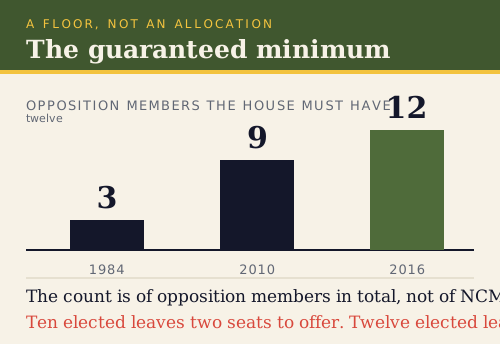
The scheme was introduced in 1984 with a minimum of three opposition members in the House, counting both elected MPs and NCMPs together. It was raised to nine in 2010, and to twelve in 2016.
The arithmetic is subtractive, and that is the part people get wrong. The minimum is not twelve NCMPs. It is twelve opposition members in total. If ten opposition candidates win their seats outright, two NCMP seats are offered. If twelve win outright, none are. The scheme only activates to fill a gap, and it shrinks as the elected opposition grows.
The 2016 change, which is the important one
Until 2016 an NCMP could not vote on everything. They were barred from voting on constitutional amendments, supply bills and money bills, votes of no confidence, and motions to remove the President. That is a specific list, and it covers most of what a chamber does when the stakes are highest.
The 2016 amendment removed those restrictions. Since then an NCMP votes on every question put to the House, on the same terms as a member who won a constituency. The distinction that remains is not about powers inside the chamber. It is about the absence of a ward outside it.
What an NCMP does not have
No constituency. This is the substantive difference, and it is larger than it sounds. An elected MP runs weekly Meet-the-People sessions, handles residents’ appeals on housing, debt and school placements, and answers for a defined area. An NCMP has none of that, because there is no area. Anyone who turns up asking for help is, formally, someone else’s resident.
No town council. Town councils manage the estates within a constituency — maintenance, conservancy charges, upgrading. They are run by the elected MPs of that constituency. An NCMP sits on none.
No claim on the next election. The seat lasts for the term of that Parliament. It confers no incumbency, no ward to defend, and no automatic candidacy anywhere.
What an NCMP does have is the floor: the right to speak in debate, to file oral and written questions to ministers, to sit on select committees, and since 2016 to vote on everything. For a party without elected seats, that is the difference between arguing in public and arguing in Parliament.
The argument for and against, stated plainly
For. The House benefits from opposition voices, and the electoral system does not reliably return them in proportion to the votes cast. A party can take a substantial share of the national vote and win almost nothing, because seats are decided constituency by constituency and GRC results move in blocks. The NCMP scheme puts a floor under representation that the arithmetic would otherwise leave uncovered, and since 2016 those members vote on everything.
Against. The objection is not usually to the presence of the members but to what the offer does. An opposition party that would otherwise have to win seats can be given them instead, which relieves pressure to compete for wards and can be presented afterwards as evidence that the House is diverse. Some opposition figures have declined the seat on exactly this reasoning, describing it as a consolation that substitutes for a mandate. The phrase used against the scheme is that it offers a seat without a constituency, which is a description both sides would accept and disagree about.
There is also a narrower objection: since the quota shrinks as elected opposition seats increase, a party that wins more constituencies gains fewer NCMP places, so the total opposition presence rises more slowly than the election result on its own would suggest.
The 2020 result, and why it changed the picture
The 2020 general election returned ten elected opposition MPs — the highest number since independence — which left two NCMP seats to be filled rather than a larger block. The same election saw the creation of the office of Leader of the Opposition, held by an elected MP with additional staff, resources and speaking priority.
Those two developments cut against the older shorthand that opposition presence in the House is principally an NCMP phenomenon. The floor still exists, but in 2020 the elected result came closer to it than at any point in the scheme’s history, and the top of the opposition benches was occupied by someone who had won a constituency outright.
How this interacts with the NMP scheme
NCMPs are often confused with Nominated Members of Parliament, and the two have almost nothing in common beyond both being unelected.
An NCMP is a defeated opposition candidate offered a seat on the strength of their vote share. An NMP is appointed by the President on the recommendation of a select committee, is expected to be non-partisan, and is drawn from fields such as business, the arts, academia, labour and community work. NMPs are not opposition members, do not count toward the opposition minimum, and are subject to voting restrictions of their own on constitutional and supply matters — the restrictions that were lifted for NCMPs in 2016.
Both schemes put unelected members in the chamber. They do so for opposite reasons: one to guarantee a floor for the opposition, the other to bring in expertise that party politics may not supply.
Declining the seat
The offer can be refused, and refusals have happened for reasons that were argued in public at the time.
The case against accepting runs like this: a party that takes a seat it did not win accepts a status that is visibly lesser, and in doing so concedes that the electoral result was adequate. The seat comes without a ward, without a town council and without the standing that comes from having been chosen. Accepting it, on this argument, trades a claim about the fairness of the system for a place inside it.
The case for accepting is more concrete. A member in the chamber can file questions, sit on committees, read papers that are not public and vote. A member outside it can do none of those. For a party whose realistic objective is to build toward winning constituencies, the argument goes, a platform inside the House is worth more than a point made by staying out.
Both positions have been held by serious people in the same parties at different times, and the balance has shifted toward acceptance as the voting restrictions were removed.
How an NCMP is counted
Two counting questions come up often enough to be worth settling.
Do NCMPs count toward the opposition minimum? Yes — that is the entire mechanism. The minimum of twelve is a total of elected opposition MPs plus NCMPs, which is why the number of NCMP seats falls as the number of elected opposition seats rises.
Do NCMPs count toward the size of Parliament? They are Members of Parliament and are listed as such, but they are additional to the elected members rather than occupying one of the constituency seats. A Parliament with ninety-three elected members and two NCMPs has ninety-five members.
NMPs are counted separately again, and do not touch the opposition minimum at all.
What the scheme reveals about the system
The NCMP arrangement exists because of an arithmetic feature of the electoral system rather than in spite of it. In a first-past-the-post system decided constituency by constituency, with most seats grouped into multi-member blocks, a party can take a substantial national vote share and convert very little of it into seats.
That is not a Singaporean peculiarity — it is how plurality systems behave everywhere, and the larger the electoral unit, the more pronounced the effect. What is particular to Singapore is the response: rather than changing how seats are allocated, the system adds a floor of members who were not elected.
Whether that is a repair or a substitute for one is the argument, and it has not been settled in forty years.
Where to check this
The NCMP provisions are in the Constitution of the Republic of Singapore and the Parliamentary Elections Act — the minimum number, the eligibility threshold, the order of offer. The 2016 amendment that removed the voting restrictions and raised the minimum to twelve was debated in Parliament that year, and the debate is in Hansard, the official verbatim record of proceedings published by the Parliament of Singapore. The list of NCMPs for a given term is published by Parliament alongside the list of elected members.
FAQOn this page
Is an NCMP elected?
No. The seat is offered to the best-performing defeated opposition candidates when elected opposition falls below the statutory minimum.
Can an NCMP vote on everything?
Since 2016, yes. Before that their votes were excluded on constitutional amendments, supply and confidence motions.
Does an NCMP run a town council?
No. There is no constituency attached, so there is no town council, no Meet-the-People session and no ward.
How is an NCMP different from an NMP?
Entirely. An NCMP is a defeated opposition candidate; an NMP is appointed on a select committee's recommendation and is expected to be non-partisan.