The system · Item 05
Who draws Singapore's electoral boundaries, and when does it happen?
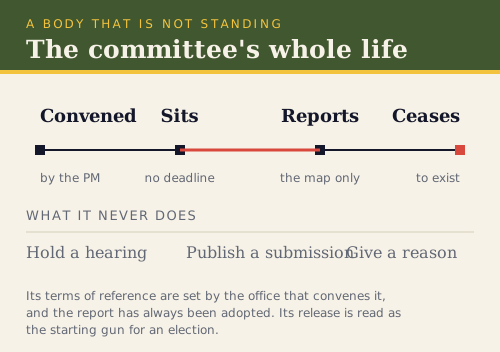
The Electoral Boundaries Review Committee. It is convened by the Prime Minister, reports without a fixed deadline, and the release of its report is generally read as the starting gun for an election.
Before a general election, someone has to decide what the constituencies are: where the lines fall, which areas are single-member seats, which are Group Representation Constituencies, and how many members each GRC returns. In Singapore that work is done by the Electoral Boundaries Review Committee — the EBRC.
Almost every notable feature of the committee follows from a single fact: it is not a standing body. It does not exist until it is convened, and it stops existing when it reports.
How it is constituted
The committee is convened by the Prime Minister, who also sets its terms of reference. It is chaired by the Secretary to the Prime Minister’s Office and its members are senior civil servants — typically including the Chief Executive of the Housing and Development Board, the Chief Statistician, the head of the Elections Department and the Chief Executive of the Singapore Land Authority.
That composition is deliberate and follows the nature of the task. Deciding where a constituency boundary falls requires knowing where people actually live, how many of them there are, how the public housing estates are laid out and where the survey lines run. Those are the offices that hold that information.
It is also the composition most criticised. The committee is not independent of the executive in the way a statutory electoral commission would be, it does not hold public hearings, it does not publish submissions, and it does not give reasons for individual decisions. Its report sets out what the constituencies will be, not why.
What it decides
Three things, and the third is the one most often overlooked.
Where the lines fall. Which streets, blocks and estates belong to which constituency.
How many constituencies there are. The total number of seats in Parliament follows from this.
What type each constituency is. Whether an area is a single-member constituency or part of a GRC, and if a GRC, how many members it returns. This is the decision that changes the arithmetic of a contest before anyone has been nominated, because a party that could field one candidate in a single seat cannot contest a five-member GRC at all.
The committee works within statutory limits. The Parliamentary Elections Act caps GRC size at six members and requires that at least a quarter of all seats be single-member constituencies, so the map cannot be made entirely of large teams.
When it happens
There is no fixed schedule. The committee is convened when the Prime Minister convenes it, and it reports when it has finished. Neither the convening nor the reporting is tied to a calendar date, a fixed interval, or the expiry of a parliamentary term.
This is why the report is read the way it is. A general election must be held within a set period after a Parliament is dissolved, and a dissolution cannot sensibly happen before the constituencies for the coming election are known. The boundaries report is therefore the last piece of public machinery that must be in place before an election can be called — and the gap between its publication and the dissolution of Parliament has sometimes been weeks and sometimes months.
The convening of the committee is often not announced at the time. In more than one instance the public learned that the EBRC had been formed some while earlier, in answer to a parliamentary question. That sequence — quiet formation, later disclosure, then a report — is itself part of why the process draws the scrutiny it does.
How the report is read
When the report appears, three things are examined immediately.
Which wards changed hands on paper. An area moved from one constituency to another takes its voters with it. Where the areas moved are ones with a known voting pattern, the effect on both the origin and the destination is arithmetical and can be estimated before any campaigning begins.
Which constituencies appeared or vanished. A GRC that is dissolved and distributed among its neighbours removes the seat that an incumbent team held. A new single-member constituency carved out of a GRC creates a contest that did not previously exist.
Which changed type or size. A four-member GRC becoming a five-member GRC raises the number of candidates an opposing party must find. A single seat absorbed into a GRC removes one of the relatively few contests a small party can realistically enter.
All three are visible in the report itself, without any need for inference about motive. What cannot be read from the report is the reasoning, because the report does not contain any.
The criticism, stated fairly
The objection is not usually that any specific boundary is indefensible. Populations move, new estates are built and old ones age, and constituencies genuinely do have to be redrawn to keep electorates roughly comparable in size. Every jurisdiction that holds elections faces this.
The objection is procedural, and it has three parts: the committee is convened by the head of government whose party contests the election; it publishes no reasons and holds no hearings; and its recommendations have always been adopted. Taken together, those mean the process cannot be audited from outside, whatever its merits in any particular case.
The response made in Parliament has been that the committee is composed of career civil servants rather than politicians, that its terms of reference are published, and that population change explains the substantive movements. Both positions have been stated repeatedly and neither has moved the other.
What “electoral divisions” means on the report
The report uses the term electoral divisions rather than constituencies, and lists each with the number of electors and the streets or blocks it contains. Comparing consecutive reports is the only way to see exactly what moved: the report describes the new map, not the difference from the old one.
That comparison is a manual exercise. It is also the only part of the process that is fully open to anyone who wants to do it, because both documents are public.
What the terms of reference say
The terms of reference are published, and they are short. They typically direct the committee to review boundaries in light of population shifts, to keep the number of electors per member within a stated range of the national average, and to recommend the constituencies for the coming election.
The range is the operative instruction. It sets how far a constituency’s electorate may deviate from the average before it must be adjusted, and it is the one quantitative constraint the committee works to. A constituency whose population has grown through new housing will breach it; so will one whose estates have aged and emptied.
What the terms do not contain is any instruction about how to weigh competing ways of fixing a breach. An over-sized constituency can be reduced by moving one area or another, and those choices have different political consequences. The committee is not told which to prefer, and does not say which it chose or why.
The electorate is the unit, not the population
A detail that changes how the report should be read: the committee works from the number of electors, not the number of residents.
Electors are Singapore citizens aged twenty-one and above who are on the register. A constituency with a large population of children, permanent residents or non-resident workers can have a modest electorate, and a smaller-looking area with an older citizen population can have a large one.
This is why the electorate figures in the report do not track the population figures anyone might have in mind from other sources, and why comparing a constituency’s size between two reports means comparing electors in both, not people.
What happens after the report
Publication is not the end of the process. The recommendations are accepted by the government and given legal effect by order, at which point the constituencies for the coming election exist in law.
The Elections Department then publishes the registers for the new divisions, candidates and parties work out where they now stand, and nomination day follows the dissolution of Parliament. The period between the report and nomination day is the only window in which a party can reorganise around a map it did not know in advance — and it has sometimes been very short.
That compression is the practical grievance most often raised by smaller parties, distinct from the procedural objection about independence. A party with deep branch structures across the island can absorb a redrawn map in weeks. A party with a handful of organised wards may find that the ward it had been working in no longer exists in the form it was working on.
The effect compounds with the GRC rule. A party that had assembled three candidates for a three-member GRC and finds that constituency merged into a five-member one has not lost a little ground; it has lost the ability to contest that seat at all, unless it can certify two more candidates inside the window. Neither the committee nor the law intends that outcome, and both produce it. It is the clearest instance of two separate features of the system — who draws the map, and how many candidates a seat requires — interacting to produce a consequence neither contains on its own.
Where to check this
The statutory limits on GRC size and the minimum number of single-member constituencies are in the Parliamentary Elections Act. The composition of each constituency for a given election, and the number of electors in each, are in that election’s Electoral Boundaries Review Committee report, published by the Elections Department. Parliamentary exchanges about when the committee was convened, its terms of reference and the reasoning behind the process are in Hansard, the official verbatim record of proceedings published by the Parliament of Singapore.
FAQOn this page
Is the committee a standing body?
No. It is convened by the Prime Minister, who sets its terms of reference, and it ceases to exist once it reports.
Does it hold hearings?
No. It holds no hearings, publishes no representations and gives no reasons. It publishes the resulting map.
Does it work from population or from voters?
From elector counts — citizens on the register — not from resident population, which is a different figure in a country with many non-citizen residents.
Why is the report read as an election signal?
Because it is the last public piece that must be in place before Parliament can be dissolved.